Hip-Hop and Black Chronopolitical Survival
On the title track of The Miseducation of Lauryn Hill, Lauryn expressed a feeling that I have become so familiar with as an adult. She contemplated the speed at which her world was moving while considering the growing distance between herself and her past. But she also articulated the suffocating feeling of life closing in on her.
I am resonating with that sentiment more frequently these days. There is something unsettling about feeling as though you are constantly doing something with your time while simultaneously feeling as though you have so little of it.
I am left to wonder how much of our relationship with time is actually ours to determine.
We tend to think of time as something that everybody has equal access to. The notion that we all have the same twenty-four hours in a day is wholly shortsighted. What we are afforded the opportunity to do within those twenty-four hours is an entirely different conversation. Who gets to rest without consequence? Who gets to imagine what their life might look like thirty years from now without feeling as though they are being overly ambitious?
These are questions of chronopolitics, which, in this context, refers to how power operates through the control and distribution of time.
Much of my recent scholarship has been concerned with the relationship between Hip-Hop and chronopolitics. Through what I call Black Chronopolitical Survival Theory, I have been exploring how Hip-Hop produces knowledge about living within and beyond conditions that threaten Black people’s access to time.
Growing Up in the Storm
As a Black millennial man, I discovered Mobb Deep before I encountered the academic language I now use to make sense of the conditions under which I came of age.
We were a generation born into the aftermath of the crack era. Mass incarceration was expanding, and zero-tolerance policies were becoming increasingly commonplace in schools. By the time many of us entered adulthood, Barack Obama’s presidency had helped popularize the absurd notion that we were living in a post-racial America.
There was an obvious contradiction in being told that the future was increasingly ours while learning from an early age that our safety within it was not even guaranteed.
Hip-Hop helped me make sense of some of these contradictions.
What Havoc was able to do through production and what Prodigy was able to communicate through his diction made pressure audible. There were things that I could hear and feel in their music that I did not yet possess the language to articulate.
For many of us, Hip-Hop was beyond a soundtrack to life. It was indeed epistemology insofar as it was a primary mode of knowing the world.
And as I consider Mobb Deep’s catalog, I find myself interrogating what their music taught me about survival and what it continues to teach me about time.
In revisiting their work, I have been developing what I call the Quiet Storm / War Outside / Infinite Model of Black Temporal Survival, a framework situated within my larger theorization of Black chronopolitical survival.
Quiet Storm Praxis
There is something about the juxtaposition of the words quiet and storm that I find useful in thinking about Black masculine interiority specifically.
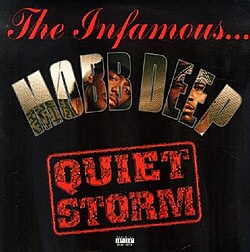
On Mobb Deep’s “Quiet Storm,” Prodigy’s delivery is remarkably calm given the weight of what he is communicating. Havoc’s production creates an atmosphere in which his composure exists alongside a sense of inevitable danger.
I have come to think of this as Quiet Storm Praxis: the emotional and psychological practices through which Black men learn to traverse feelings that cannot always be safely conveyed.
A raised voice can be heard as aggression while tears can be converted into weakness. Silence can be interpreted as guilt while vulnerability can become a liability.
I am wondering what a person might learn about themselves when they are repeatedly made to consider the consequences of other people’s interpretations of their own emotions.
Kevin Quashie’s The Sovereignty of Quiet has been particularly helpful in how I think about Black interiority. His work invites us to consider the richness of Black interior life beyond its relationship to public resistance. I also think about bell hooks’s We Real Cool and the emotional consequences of the expectations placed upon Black men via racial capitalism and patriarchy within society.

Through Quiet Storm Praxis, I am interested in the knowledge that informs the decision to withhold or express an emotion in a particular environment, rather than endorsing emotional suppression.
Prodigy positioning his writing as a form of prescription is brilliant. Writing becomes a space where interior pressure can be converted into something that might provide care for oneself and, eventually, for someone else.
The storm may be quiet to those around us, but that does not change the fact that something is indeed happening within us.
War Outside Praxis

Four years before “Quiet Storm,” Mobb Deep released “Survival of the Fittest.”
Where I locate much of the theoretical significance of “Quiet Storm” within the interior, “Survival of the Fittest” I understand as an examination of the exterior conditions that necessitate such interior work, of which I call War Outside Praxis.
Think about the amount of intellectual labor that goes into inheriting and trying to understand an environment. Knowing when to speak and when to leave. Being cognizant of how your presence might be interpreted before you have even said anything. These are learned practices and much of this learning occurs informally.
Hip-Hop has historically been one of the spaces through which this knowledge is passed around. An emcee’s depiction of their environment and what they go through can become instructional for someone who has yet to have similar experiences themselves.
There is a communal dimension to this that can get lost when we discuss survival through the language of individual strength. Much of what we know about how to survive comes from what other people have shared with us about their experiences.
I am left to consider how much time is swallowed by the intellectual and emotional labor required to work through environments that demand this level of attentiveness.
Infinite

In 2025, Mobb Deep released Infinite, eight years after Prodigy’s death.
The title itself provides space to consider survival and time. Premature death is not only something that happens at the end of a person’s life. The expectation of premature death can influence how someone experiences the life they are presently living. This is something Prodigy discussed often including in his book My Infamous Life.
I think about how many of the Black men whose voices accompanied my childhood never had the opportunity to become elders and it’s heartbreaking for me.
What might Tupac have been talking about at 55? How might his relationship with Hip-Hop have changed as he watched subsequent generations come into the culture?
Beyond the loss of their lives, there was a loss of time in which they could have continued to develop their ideas. There were conversations we never got to have with them.
Ruth Wilson Gilmore’s work on racism and premature death helps me think about this loss as a question of power rather than just inevitability.
This is where I locate the third dimension of my framework: Infinite. Infinite concerns what is made possible when Black life and Black knowledge exceed the timelines imposed upon them.
Prodigy lived much of his life with the pain of having sickle cell disease. His writing provided an archive of that experience, among the many other experiences that informed his relationship with the world.
On “Pour the Henny,” from Infinite, we hear Prodigy contemplating his mortality alongside Nas. There is something theoretically significant about listening to a living artist in conversation with the recorded voice of an artist who is no longer physically here in a way that seems authentic given their previous history as collaborators and peers.
Prodigy’s life ended in 2017. However, my relationship with what he has taught me did not.
And there are people who may encounter Prodigy for the first time through music released after his death.
I am interested in the knowledge that becomes possible through the continuation of Black life. That continuation extends across generations through what we create in our lifetime and what remains accessible to those who come after us.
The Promise of the Infinite

In 1999, the same year Mobb Deep released “Quiet Storm,” Yasiin Bey, then known as Mos Def, released Black on Both Sides.
On “Love,” Bey connects living in the present to the promise of the infinite.
Whereas Mobb Deep has me considering what it means for Black life and knowledge to continue beyond an anticipated ending, Bey has me interrogating how we might live within the time that precedes that ending.
The implications of that relationship between the now and the infinite are compelling to me. Particularly because so much of how we are encouraged to live in the present involves what feels like fake urgency. There is always something else we are seemingly supposed to be doing. Something else we are seemingly supposed to have accomplished by now.
Through Yasiin Bey’s artistry, I have been developing a concept over the past year that I call Chronopolitical Refusal. I am interested in what it means to refuse the authority that externally manufactured timelines have over our understanding of ourselves. And what happens when we allow ourselves the time to contemplate something without feeling compelled to immediately produce something from that contemplation.
I wonder if living in the now has to mean exhausting ourselves in the present for the sake of securing a future. Perhaps part of securing that future involves being more protective of the time in which we are presently alive.
Beyond Survival
I refuse to allow the knowledge that Black people have developed through surviving oppressive conditions to become another reason to expect us to endure those conditions.
There is a thin line between recognizing the intellectual significance of survival and romanticizing the necessity of it.
Through Black Chronopolitical Survival Theory, I am interested in what Hip-Hop has taught us about protecting our interior lives and extending our presence beyond what has been forecast for us.
But I am just as interested in what the culture might teach us about living when survival no longer has to be our primary preoccupation. I wonder what possibilities emerge for how we might spend our time when so much of it is no longer devoted to figuring out how to survive.
Leave a Reply